Moving an enterprise website from one content management system to another involves much more than learning where content fields and publishing buttons live.
At Billtrust, we were preparing to move our marketing website from WordPress to Sitecore as part of a much larger rebuild of our global digital presence. The new platform needed to support an increasingly complex enterprise environment spanning multiple markets, languages, integrations, marketing technologies, and teams.
Because I would be deeply involved in building and ultimately managing that platform, I wanted to understand Sitecore beyond the implementation work immediately in front of me.
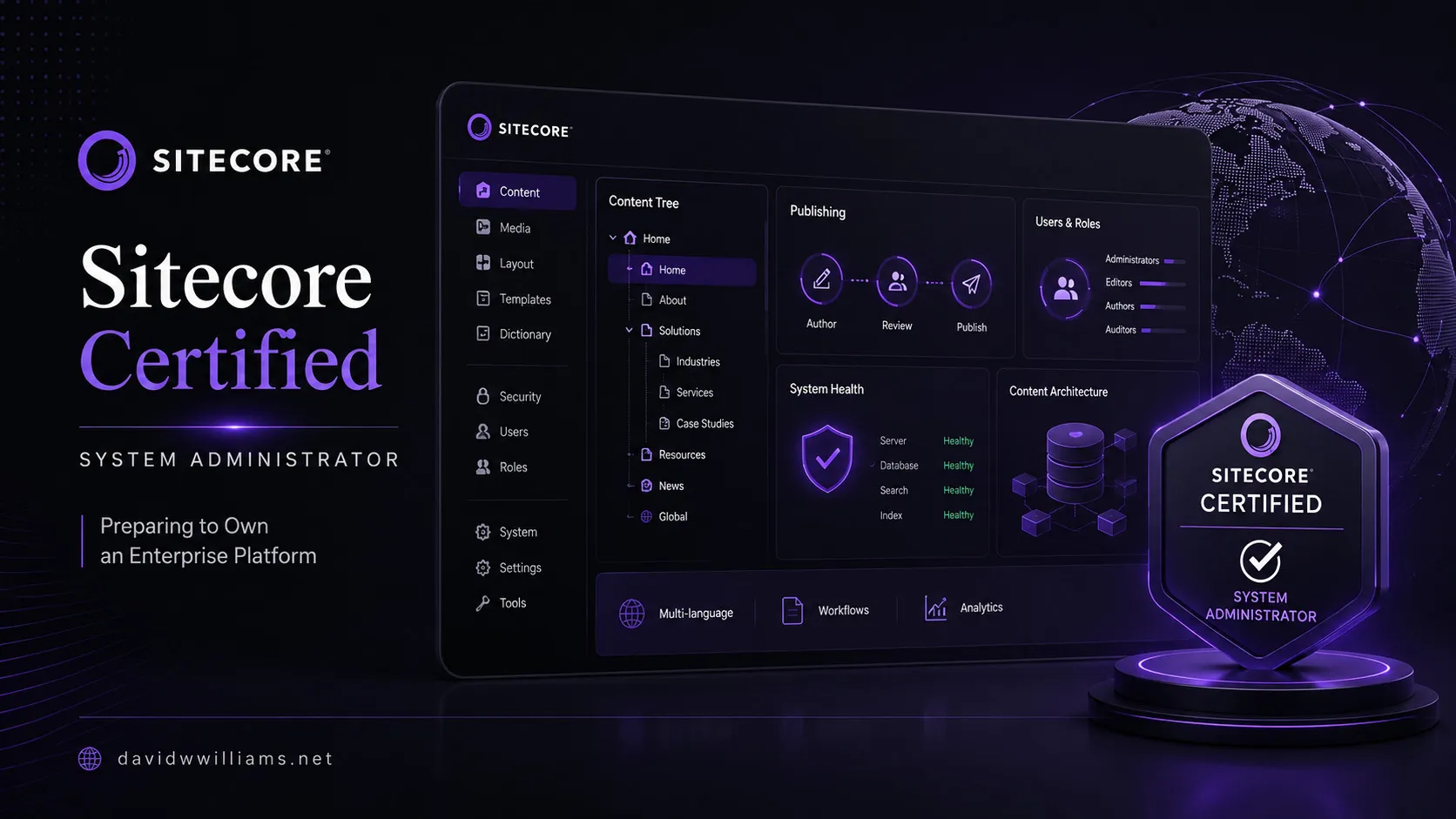
So I enrolled in the Sitecore System Administrator eLearning Certification Bundle for Sitecore 10 and ultimately earned my Sitecore 10 System Administrator Certification.
Why I pursued the certification
I’ve worked with several content management systems throughout my career, and one thing I’ve learned is that knowing how to build something in a CMS isn’t the same as understanding how the platform itself operates.
That distinction becomes increasingly important at the enterprise level.
A website can involve frontend development, templates, components, integrations, analytics, SEO, accessibility, and content workflows while also depending on an underlying platform architecture that needs to remain secure, maintainable, performant, and reliable.
With Sitecore becoming a critical part of Billtrust’s digital infrastructure, I wanted a stronger understanding of that entire system.
Rather than learning only the pieces I needed as questions arose, I decided to work through Sitecore’s formal System Administrator training.
Going beyond content management
The certification path covered a much broader range of responsibilities than simply administering website content.
The Sitecore 10 System Administrator curriculum and certification focus on areas such as:
- Sitecore’s Control Panel and administrative settings
- Publishing and workflow
- User and role management
- Supporting content authors
- Sitecore architecture
- Installation, updates, and upgrades
- Performance optimization and health monitoring
- Sitecore support processes
For me, that breadth was exactly what made the training valuable.
I wasn’t looking to become someone who simply knew how to use Sitecore’s interface. I wanted to understand how the platform fit together and what was required to operate it successfully over time.
Understanding the platform behind the website
One of the most useful aspects of the training was developing a stronger mental model of Sitecore as a platform rather than viewing it only through the website sitting on top of it.
Enterprise websites rarely exist in isolation.
They depend on infrastructure, environments, deployment processes, permissions, publishing workflows, caching, integrations, monitoring, and governance. Decisions in one area can have downstream consequences elsewhere.
Understanding those relationships makes it easier to troubleshoot problems, evaluate architectural decisions, communicate with infrastructure and development teams, and make better long-term decisions about the platform.
That’s particularly important in a role like mine, where the responsibility often extends across both the customer-facing experience and the technologies powering it.
Why the administrator perspective matters
I spend a significant amount of my time working at the intersection of development, digital marketing, analytics, SEO, accessibility, performance, and marketing technology.
That means I don’t necessarily fit neatly into a traditional frontend developer, backend developer, CMS administrator, or digital marketer role.
And I see that as an advantage.
Learning the administrative side of Sitecore gave me another perspective on the same platform I would be helping architect and build.
When you’re responsible for an enterprise website, the job doesn’t end when the code deploys.
Someone needs to think about questions like:
- How will content teams safely manage and publish content?
- How should permissions and roles be structured?
- What happens when the platform needs to be upgraded?
- How do we identify performance or platform health issues?
- How do different Sitecore environments and services interact?
- How do we build something that can be maintained long after launch?
Those questions are just as important as how a component is coded.
Turning training into platform ownership
I also approached the certification differently than I would have earlier in my career.
The goal wasn’t simply to add another credential to my résumé.
It was to become better prepared to take ownership of an enterprise platform.
As our Sitecore implementation evolved, I could connect what I was learning to the actual decisions involved in building and operating the new Billtrust website.
That combination of formal training and practical implementation is where I find certifications most valuable.
The coursework provides the framework.
Real-world implementation provides the context.
And working with both creates a much deeper understanding than either one alone.
Expanding my multi-CMS experience
Sitecore also added another important platform to the CMS experience I’ve developed throughout my career.
I’ve worked across systems including WordPress, Drupal, SharePoint, and other web platforms, each with different strengths, architectural approaches, and operating models.
Learning Sitecore reinforced something I’ve come to value more over time: CMS expertise shouldn’t be limited to knowing one CMS extremely well.
Understanding multiple platforms makes it easier to separate fundamental web architecture principles from platform-specific implementation details.
Content modeling, governance, publishing workflows, performance, accessibility, SEO, integrations, analytics, security, and scalability exist regardless of the CMS.
The implementation changes.
The underlying problems often don’t.
That broader perspective becomes particularly valuable when evaluating platforms, planning migrations, or determining how technology should support an organization’s larger digital strategy.
Earning the Sitecore certification
After completing the training and preparing with the Sitecore System Administrator Certification Study Guide, I took the Sitecore 10 System Administrator Certification Exam and passed it.
That officially made me a Sitecore Certified Professional / Sitecore 10 Certified System Administrator.
I’m proud of the certification, but the credential itself isn’t the part I value most.
What mattered was developing a stronger understanding of the platform I would be responsible for helping build, launch, manage, troubleshoot, and continuously improve.
Final thoughts
Technology changes constantly, and working in web technology means continually becoming comfortable with platforms, tools, and architectures that may not have been part of your stack a few years earlier.
I’ve never wanted my experience to be defined by a single CMS or technology.
I want to understand the larger digital ecosystem: how the platform is architected, how content moves through it, how users experience it, how marketing technology connects to it, how its performance is measured, and how teams can operate it effectively.
Becoming a Sitecore 10 Certified System Administrator was another step in building that broader perspective.
And as we continued toward the launch of Billtrust’s new global Sitecore platform, that knowledge gave me a much stronger foundation for what mattered most: not simply implementing another CMS, but helping build an enterprise digital platform that we could successfully own and evolve.